
Last updated November 17, 2026
 AC repair
 Furnace & heating
 Heat pumps
 Ductless mini splits
 Carrier
 Trane
 Goodman
Seasonal tune-up and full diagnostic on your Carrier, Trane, or Goodman system - readings shown to you before any repair is proposed
Diagnosis first, numbers second - you approve the repair price before a single part goes in.
Get your free estimateHVAC Emergency Preparedness Guide for Spring Valley Homes
During the July 2023 heat event, Clark County cooling centers filled to capacity within two hours of opening. Homeowners who had a cooling plan – a specific hotel, a family address, a neighbor with a working unit – got out of the heat. Homeowners who didn’t had no good options at noon on a Sunday. That gap between the two groups wasn’t luck. It was preparation done weeks earlier. This guide covers what to do in the first 30 minutes of an AC failure on a 110°F day, where Clark County cooling centers are and how to check them during a declared heat emergency, the exact question that gets you an honest answer from a dispatcher, and the steps to take now so that a Spring Valley HVAC emergency never catches your household flat-footed.
Quick Answer
If your AC fails in Spring Valley on a day above 105°F, the first priority is moving vulnerable people out of the heat within 4 to 6 hours – not waiting on a technician. Call for service immediately, but treat the repair call and the cooling plan as two separate tracks running at the same time. Have your system model, age, last service date, and a plain description of the symptom ready before you dial, so the call takes five minutes instead of twenty. And confirm the written emergency rate cap before anyone is dispatched.
Styles & brands we work with
- AC repair
- Furnace & heating
- Heat pumps
- Ductless mini splits
- Carrier
- Trane
- Goodman
Table of Contents
- The First 30 Minutes of an AC Failure on a 110°F Day
- Why a Spring Valley HVAC Emergency Is a Health Emergency
- Clark County Cooling Centers: Locations, Hours, and Status
- The Question to Ask a Dispatcher That Gets an Honest Answer
- What to Have Ready Before You Call for Emergency Service
- Preparation Steps to Take Now, Before an Emergency
- What an Emergency Rate Should Cap At in Writing
- Spring Valley’s Two Emergency Seasons
The First 30 Minutes of an AC Failure on a 110°F Day
Indoor temperatures in a Spring Valley home with failed central air can climb past 95°F within an hour on a July afternoon. The sequence below buys you time while a technician is en route. It’s not about fixing the system – it’s about protecting the people inside it.
- Get every person into the coolest room in the house. Ground floor, north-facing side, away from exterior walls. Close doors to unused rooms so you’re cooling a smaller volume.
- Close blinds and drapes on every sun-facing window. West- and south-facing glass is the biggest heat gain in a Spring Valley afternoon. Blocking it can drop indoor temps 5 to 10 degrees.
- Move air with box fans and ceiling fans – but not toward yourself if the air is above your body temperature. Fans above roughly 95°F indoor air push heat at you rather than cool you. Use them to exhaust hot air out windows instead.
- Wet cloths on wrists, neck, and ankles. Evaporative cooling works in dry air, and Spring Valley’s single-digit humidity in summer makes it effective. This is the old desert trick, and it works.
- Drink water on a schedule, not on thirst. Older adults lose thirst response with age. Set a timer for every 30 minutes.
- Call for service while you do steps 1-5, not afterward. Every minute matters on the dispatch queue.
If anyone in the household is 65 or older, has a heart condition, takes diuretics or blood pressure medication, or is under two years old, skip steps 3 through 5 and go straight to your secondary cooling plan. Those groups hit heat illness thresholds faster than healthy adults, and a Spring Valley afternoon in July doesn’t leave much margin.
Why a Spring Valley HVAC Emergency Is a Health Emergency
Heat is the leading weather-related cause of death in the United States, and Clark County is one of the places where that stat has real teeth. Indoor heat is worse than outdoor heat in one specific way: people don’t recognize they’re in danger because they don’t think of their own living room as a hazard. Elderly residents are found in homes with indoor temperatures over 100°F every summer in the Las Vegas valley.
The 4-to-6 hour window is not a rough guess. It’s the point at which core body temperature in an un-cooled home on a 110°F day starts climbing past the body’s ability to shed heat, particularly for people whose thermoregulation is already compromised. Heat exhaustion symptoms – dizziness, nausea, headache, heavy sweating that stops – can turn into heat stroke quickly once they begin.
What that means practically: an HVAC emergency in Spring Valley is not measured in how long until the technician arrives. It’s measured in how long until the most vulnerable person in your house is somewhere cool. Those are different clocks, and the second one runs faster.
If you’re already in a no-cooling situation and someone is showing confusion, hot skin, or has stopped sweating, call 911 before you call an HVAC company. Emergency dispatch can get a person to a cooling center or hospital in minutes. We can’t.
Clark County Cooling Centers: Locations, Hours, and Status
Clark County activates cooling centers during declared heat emergencies, and the list changes day to day based on which facilities are open. The reliable way to find current locations and hours is to call 2-1-1 or check the Clark County website’s heat resource page during a declared event. Libraries, community centers, and senior centers are the typical host locations. Spring Valley and the surrounding west-side neighborhoods have several within a short drive.
What to know before you go:
- Hours are posted, not 24-hour by default. Many centers close in the early evening, which is often right when a failed AC is most dangerous. Check the closing time before you head over.
- Bring your own water and any medications. Centers supply cooling space, not supplies.
- Pets are not universally allowed. Confirm before bringing an animal.
- Senior centers often operate transport. If you have an elderly neighbor in Spring Valley without a car, this matters.
During the 2023 event, capacity was reached within about two hours at multiple sites. That’s not a reason to skip the cooling center – it’s a reason to have a second option. A specific hotel name (budget chains on Flamingo and Tropicana often have same-day availability), a family address across town, or a neighbor with a working unit are all viable. The key word is specific. “We’ll figure something out” is not a plan. “We go to my sister’s in Henderson” is.
The Question to Ask a Dispatcher That Gets an Honest Answer
Most homeowners ask “how soon can you get here?” That question invites an optimistic answer, because the person on the phone wants your business. The better question is different.
Ask: “Is this a same-day repair with parts you already have, or does it need a part order?”
That question forces the dispatcher to think about the actual failure mode. A capacitor, contactor, or blower motor is typically a same-day fix – those are common parts on any service vehicle. A compressor, condenser coil, or control board for an older Carrier or Trane unit often requires a parts order and a day or more. Getting that answer up front changes how you plan the next 24 hours.
Follow up with: “What’s the written price before anyone comes out, including any after-hours rate?” A company that prices in writing will give you a number. A company that won’t is telling you something.
In our experience, the technicians most likely to give you a straight answer on parts availability are the ones backed by a written price and a written guarantee. Dalton Heating & Air Spring Valley answers the phone with a live person 24/7, no voicemail queue, and the price is in writing before any work starts. Compare that to a call-center that can only promise a window you have to trust. If you’re weighing a call, our AC Repair in Spring Valley page lays out what a typical repair call looks like from dispatch to finish.
What to Have Ready Before You Call for Emergency Service
A five-minute call gets you a faster dispatch than a twenty-minute one. Gather this before you dial:
- System model and serial number. On the outdoor condenser unit, on a data plate under a service panel. A photo on your phone works.
- Approximate age of the system. If you don’t know, the manufacture date is often in the serial number – the dispatcher can decode it.
- Last service date. Even a rough estimate (“last spring”) helps the technician narrow the likely failure.
- The exact symptom. Not “it’s broken.” Is the outdoor fan spinning? Is the indoor blower running? Is the thermostat blank? Does it click and shut off after a minute? Warm air from the vents, or no air at all?
- Any sounds or smells. A clicking relay, a buzzing contactor, a musty smell in the ducts, a burning smell – each points to a different likely cause.
- Your address and gate or access code. Sounds obvious until a technician is standing at a locked gate in 108°F.
Writing all of this on one index card and taping it inside the closet with the air handler takes ten minutes and is worth every second during an actual emergency. We’ve seen calls stretch to fifteen minutes because nobody could find the model number.
Preparation Steps to Take Now, Before an Emergency
The work that makes a Spring Valley HVAC emergency survivable is done in the cool months. Three categories matter most: a secondary cooling plan, a written service agreement with a guaranteed response window, and a documented emergency rate cap.
- Write down your secondary cooling plan. Not mentally. On paper. Name the specific hotel, the specific family address, and the specific neighbor. Note whether the hotel takes pets. Note the drive time. Keep it in the same place as your emergency contacts.
- Get a written service agreement that states a response window in hours, not “as soon as possible.” The Garrison Standard requires a stated window, and we hold to it. Ask any company you’re considering to put the response window in the contract, not on a brochure.
- Confirm the emergency rate in writing before you need it. An after-hours call should carry a stated cap. You should know what that number is before a Sunday night, not after.
- Schedule a spring tune-up. A system that gets checked in April is far less likely to fail in July. Most seasonal failures we see are preventable – a dirty coil, a weak capacitor, a refrigerant charge that was already low in May.
- Note where the breaker and the condensate drain are. A tripped breaker or a clogged drain line are the two most common “emergencies” that a homeowner can fix in five minutes. A wet closet floor from a backed-up drain is not a compressor failure.
If you’re due for a tune-up or a maintenance agreement, our Furnace Repair in Spring Valley and heating service pages cover the flip side of the same conversation – because a Spring Valley home that runs hot in July usually has a furnace that runs hard in January. Full service details live on the Dalton Heating & Air Spring Valley home page.
What an Emergency Rate Should Cap At in Writing
Emergency rates in the Las Vegas valley vary. What we’ve seen in Spring Valley service calls runs roughly $50 to $125 above the standard diagnostic fee for after-hours dispatch, and the diagnostic fee itself runs $75 to $150 for a first visit on a residential system. A same-day repair on a common part – capacitor, contactor, blower motor – typically lands in the $250 to $500 range including the diagnostic. A compressor or control-board repair runs considerably higher, often $600 to $1,800 depending on the brand and the part.
What matters isn’t the exact number. It’s that you know yours before you call. Here’s what a written emergency rate should include:
- The after-hours differential stated as a specific dollar amount. Not “additional charges may apply.”
- The diagnostic or dispatch fee stated separately. This is often the number people are surprised by at the door.
- The repair cost quoted before work starts, in writing, based on the technician’s diagnosis. Not estimated, quoted.
- A written guarantee on the repair. At Dalton, the repair is guaranteed in writing for a full year, and if it fails in that time, we return at no charge. A 30-day window isn’t the same thing.
Any company that won’t put those four items in writing before a technician arrives is telling you what to expect at the door. The industry has a name for that pattern: the surprise. You’re reading this guide to avoid it.
Spring Valley’s Two Emergency Seasons
Spring Valley runs two HVAC emergency seasons, and they’re about four months apart. The summer emergency is a cooling failure on a day over 105°F, which is what this guide mostly addresses. The winter emergency is a heating failure on a night when overnight temps drop into the mid-30s, which happens a handful of times every January and February in Spring Valley.
The winter version is less discussed but has a similar 4-to-6 hour window for elderly residents. A house that loses heat at 8pm and isn’t repaired until morning can drop to the 50s by 3am. That’s uncomfortable for most adults and genuinely dangerous for anyone with a compromised immune system or limited mobility.
If your system is a heat pump, the transition matters even more – a heat pump that’s failing to cool in July may also be failing to heat in January. The same reversing valve, compressor, and control board serve both. A homeowner who gets a cooling failure fixed in summer is often getting ahead of a winter failure too. If you’re considering replacing a system that’s shown signs of strain, our Heat Pump Installation in Spring Valley page covers the sizing and load-calculation side – and installation is scheduled, not same-day, so plan it before the next season, not during one.
Common Mistakes to Avoid
- Waiting to call because you think it’ll cool down after sunset. In a Spring Valley July, indoor temps often stay above 85°F until 10pm. Overnight relief is not reliable.
- Setting the thermostat to 60 to “force” the system to work harder. It won’t. A failed system doesn’t fail faster by being asked to try harder – and a working system runs the same either way. Set it to a normal target and leave it.
- Opening every window to “get airflow.” On a 110°F day, opening windows pulls 110°F air inside. Close the house up. Ventilate at night if overnight temps actually drop below indoor temps, which they often don’t below about 3am.
- Not writing down the model number before the call. The dispatcher can’t tell you whether your unit is a same-day or parts-order repair without it. Five minutes of prep saves hours of ambiguity.
- Accepting “we’ll be there sometime between 8 and 4.” A stated window is a commitment. A four-hour window isn’t. The Garrison Code requires arrival inside the stated window, and any company worth calling should state one.
- Hiring a company that won’t quote before dispatch. If the after-hours fee isn’t in writing before the technician leaves the shop, you’re not getting a price. You’re getting a negotiation.
- Skipping the spring tune-up because “it worked fine last summer.” Most July emergencies in Spring Valley are the second or third summer of a slow-developing problem. Tune-ups catch them at the first or second.
See the difference
 Before
 After
 Before
 After
 Before
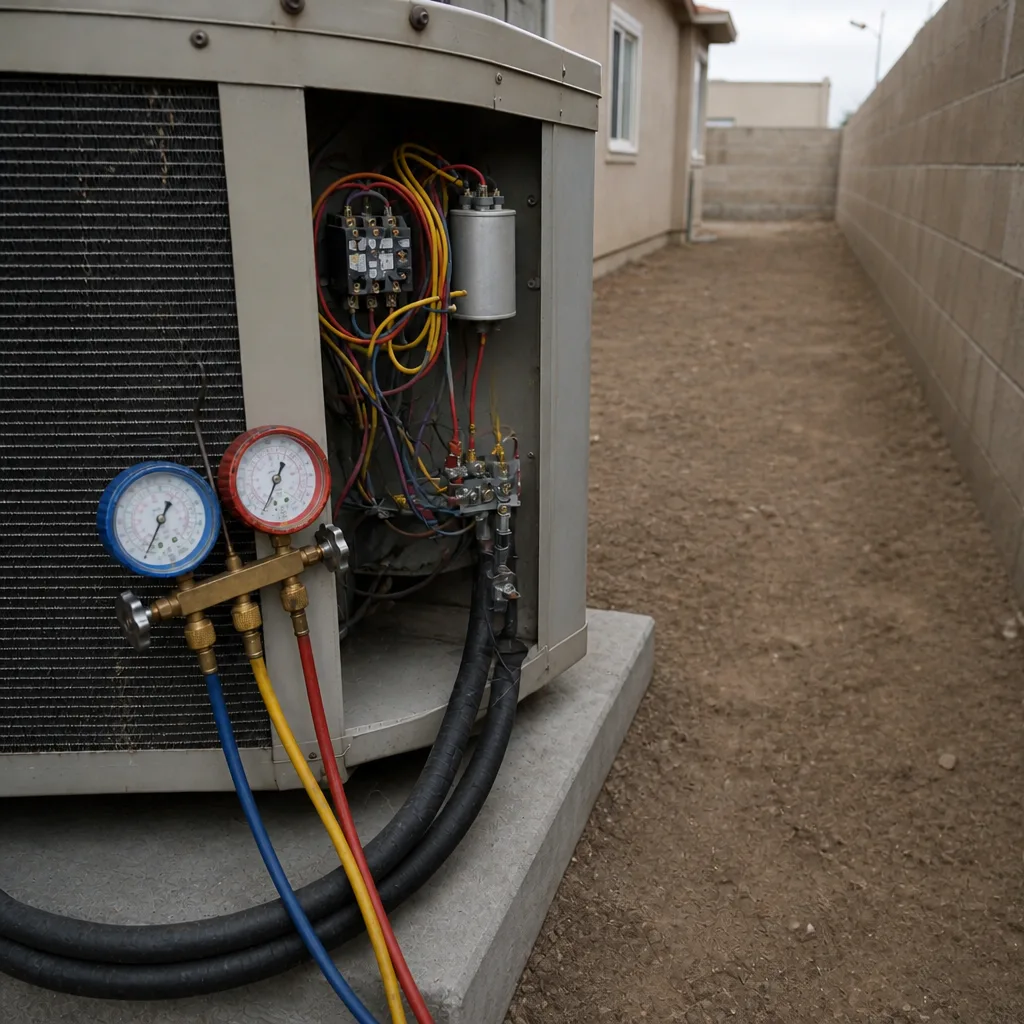 After
When to Call a Professional
Call a professional immediately if the system won’t cool and anyone in the household is in a high-risk heat category. Call if you smell burning, hear a hard mechanical knock, or see ice on the refrigerant lines – icing usually means a refrigerant or airflow problem that gets worse the longer it runs. Call if the outdoor fan isn’t turning but the indoor blower is. Call if the system short-cycles more than three times in an hour.
Do not open the outdoor unit or try to diagnose the compressor or electrical components yourself. High-voltage capacitors hold a potentially lethal charge even after power is cut, and refrigerant under pressure is not a homeowner repair. That’s the specific reason we don’t give step-by-step DIY instructions here.
Dalton Heating & Air Spring Valley offers free estimates in Spring Valley – call (888) 268-6106. A live person answers 24/7, and the price is in writing before any work starts.
Frequently Asked Questions
For healthy adults, a Spring Valley home without AC on a day over 110°F stays uncomfortable but generally survivable for many hours. For elderly residents, infants, or anyone with a heart condition or on certain medications, indoor heat can become dangerous within 4 to 6 hours. The key step is getting those people out of the house and to a cooling center, hotel, or neighbor before that window closes, not waiting for the repair. Call (888) 268-6106 for service, but also execute your cooling plan in parallel.
Clark County activates cooling centers during declared heat events, and the current list is available by calling 2-1-1 or checking the Clark County website. Locations are typically libraries, community centers, and senior centers, and several are a short drive from Spring Valley. Hours are posted and most centers are not open 24 hours, so confirm the closing time before you go. During the July 2023 event, multiple sites filled to capacity within two hours of opening – have a second option in mind.
Sometimes yes, sometimes no, and the honest answer depends on the specific failure. Common repairs – capacitors, contactors, blower motors, thermostats – are usually same-day because those parts are standard on any service vehicle. Failures involving the compressor, condenser coil, or a control board for an older Carrier or Lennox unit often require a parts order. The question to ask the dispatcher is direct: “Is this same-day with parts on hand, or does it need a part order?” A straight answer up front lets you plan.
After-hours dispatch in the Las Vegas valley typically runs $50 to $125 above the standard diagnostic fee, and the diagnostic itself runs $75 to $150 on a first visit. Same-day repairs on common parts commonly land between $250 and $500 including diagnostic. Larger repairs run $600 to $1,800 depending on the part and the brand. We put the price in writing before any work starts – call (888) 268-6106 for an exact quote.
Have your system model and serial number, approximate age, last service date, a plain description of the symptom, and any sounds or smells. Also have your address and any gate or access code. A five-minute call with all of this ready gets a faster dispatch than a twenty-minute call without it. Write it on a card and tape it inside the closet with the air handler now, before you need it.
An after-hours differential is standard in the trade, and you should know the number before you dial. We state the after-hours rate in writing before dispatch, and the repair price is quoted in writing before work starts. Every repair carries a full-year written guarantee – if it fails inside that year, we return at no charge. Call (888) 268-6106 and ask for the after-hours rate up front; any company worth hiring will give it to you.
The Bottom Line
An HVAC emergency in Spring Valley is a heat emergency first and an equipment problem second. The preparation that makes it survivable is a written cooling plan with a specific hotel or family address, a documented service agreement with a stated response window, and a known emergency rate cap. When the AC fails on a 110°F afternoon, call for service immediately – but also act on the cooling plan in the same hour, not after the technician’s ETA. That dual-track approach is the whole guide in one sentence. The people in the house matter more than the machine in the yard, and the machine can wait.
Call Dalton Heating & Air Spring Valley at (888) 268-6106 for a free estimate. A live person answers 24/7, the price is in writing before any work starts, and every repair is guaranteed in writing for a full year. Our technicians have up to 23 years of experience and are factory-trained on Carrier, Trane, Lennox, and Goodman systems.
Written by the team at Dalton Heating & Air Spring Valley.