
Last updated November 17, 2026
 AC repair
 Furnace & heating
 Heat pumps
 Ductless mini splits
 Carrier
 Trane
 Goodman
Seasonal tune-up and full diagnostic on your Carrier, Trane, or Goodman system - readings shown to you before any repair is proposed
Diagnosis first, numbers second - you approve the repair price before a single part goes in.
Get your free estimateFurnace Repair Troubleshooting: Common Problems and How to Fix Them
Your furnace flashed a code and shut down. That two-digit number blinking on the control board is worth understanding before you call a tech – it’s the difference between a $90 sensor cleaning and a $600 misdiagnosis. Modern furnaces are built to tell you what failed; manufacturers put diagnostic LED charts right inside the unit. Most homeowners never look. This guide teaches you to decode that blink pattern, map the five most common failure points to their symptoms, and know which faults mean “reset it” versus “keep it off.” If you’re in Spring Valley and your heat just quit, you’ll walk away with a written description of what your furnace is actually complaining about.
Quick Answer
Most furnace failures trace to one of five parts: the igniter, flame sensor, pressure switch, inducer motor, or limit switch. Read the diagnostic LED code chart behind the burner access panel, match the blink pattern to the legend, and record it. A single lockout after a failed ignition attempt usually resets safely; a code pointing to a cracked heat exchanger or repeated limit trips means leave the furnace off and call a professional.
Styles & brands we work with
- AC repair
- Furnace & heating
- Heat pumps
- Ductless mini splits
- Carrier
- Trane
- Goodman
Table of Contents
- How to Find and Read Your Furnace’s Diagnostic Code
- The Five Most Common Furnace Failure Points
- Which Faults You Can Reset and Which Mean Stop
- Blower Runs But No Heat: The Diagnostic Tree
- Furnace Won’t Start At All: The Diagnostic Tree
- What to Write Down Before the Service Call
- Why Spring Valley Furnaces Fail Differently
How to Find and Read Your Furnace’s Diagnostic Code
Every modern furnace since the mid-1990s carries a control board with a diagnostic LED – usually a small red or green light that blinks in patterns. The code chart that decodes those blinks is a sticker printed on the back of the lower burner access panel or on the blower door. Manufacturers put it there for a reason: so a technician can read it in seconds. You can too.
Here’s the process, step by step. It’s observation only – you’re reading a light, not touching gas or wiring.
- Turn off the thermostat call for heat and let the furnace finish its cycle, then power the unit down at the wall switch (usually a toggle switch near the furnace).
- Remove the lower burner access door. On most units this lifts up and out, or the panel pulls toward you after one screw or two. Don’t remove the sealed door above it – that’s the heat exchanger compartment.
- Restore power. Watch the board: the LED will blink a pattern within about 30 seconds, then pause, then repeat.
- Count the blinks between pauses. Two blinks, pause, two blinks means code 2-2 on a Carrier or Bryant board; one long and three short on a Goodman often means code 13. Write the pattern down exactly as you see it.
- Match the pattern to the chart printed on the back of the door you just removed, then photograph both the chart and the blinking light with your phone.
On a Rheem or a York, the chart is worded slightly differently but the logic doesn’t change. Carrier and Bryant share a lineage of boards and often use the same scheme. If the chart is missing or unreadable, that photo of the blinking light is still gold to a tech.
This is a furnace repair troubleshooting step most homeowners skip, and it costs them. The code narrows the field from “something is wrong” to two or three candidate parts. Our technicians have up to 23 years of experience and know these boards cold – but when you bring the code, the diagnosis gets faster and the estimate gets tighter. For a broader look at what your options are when the heat goes down, see our Furnace Repair in Spring Valley page.
The Five Most Common Furnace Failure Points
Across all nine major brands we’re trained to service – Carrier, Trane, Lennox, Goodman, Rheem, York, Daikin, Bryant, and American Standard – the same five parts account for the overwhelming majority of no-heat calls. Here’s the symptom-to-cause map, with realistic price ranges should a part need replacing.
- Hot surface igniter. Symptom: you hear the inducer fan run, but no click of gas igniting; sometimes the furnace tries three times then locks out. The igniter is a ceramic element that glows orange to light the burner – it’s fragile and cracks easily. Replacement runs about $120-$220 installed.
- Flame sensor. Symptom: burners light for 5-10 seconds, then shut off; the furnace tries again and eventually locks. The sensor is a metal rod that tells the board “flame is present” – a dirty rod can’t sense the flame and the board shuts the gas off as a safety measure. Cleaning runs about $90-$150; replacement adds a bit.
- Pressure switch. Symptom: the inducer fan runs, but the burners never light, and the code reads a pressure switch fault. This switch confirms the exhaust vent is drawing properly. A failed or stuck switch, or a blocked vent or drain line, will stop the furnace cold. Replacement runs $150-$350 depending on whether vent work is involved.
- Inducer motor. Symptom: no fan sound at all at the start of the cycle, or a loud bearing noise, or a code indicating pressure switch open. Before the burners light, this motor has to pull air through the heat exchanger and vent. A seized motor means no ignition. Replacement runs $350-$650 installed.
- Limit switch. Symptom: the furnace runs, then shuts off before the thermostat is satisfied, and the blower runs a long time afterward; repeated trips. The limit switch is a temperature safety – it trips when the heat exchanger gets too hot, often because of restricted airflow from a clogged filter, blocked return vent, or failing blower. A filter change costs $15-$30; a blower motor replacement runs $400-$800.
One detail our trade wears like a badge: the flame sensor and the limit switch are the two most common small failures on furnaces that fail the very same way every year. Goodman and Rheem units tend to be the most straightforward to service; Daikin’s inverter communicating systems take a different diagnostic path. If your home is running central air, some of the same blower and airflow issues show up on the cooling side too – see AC Repair in Spring Valley.
Which Faults You Can Reset and Which Mean Stop
Here’s the part that separates a smart homeowner from a lucky one. Some fault codes mean “the furnace tried and couldn’t, so it shut itself off to be safe” – a reset is a reasonable first step. Others mean “do not run this furnace until a trained technician looks at it.”
Safe to reset (single lockout):
- A code indicating “ignition lockout” after failed attempts, if it’s the first time and the filter is clean. Cycle the power switch off for 30 seconds, restore power, and watch one full cycle.
- A code from a pressure switch that tripped once, if the vent pipe has no visible obstruction and the condensate drain is clear. A high-efficiency furnace in Spring Valley during a cold, windy stretch can occasionally trip a pressure switch from wind pressure – one trip is worth one reset.
Stop and call a professional:
- Any code or condition pointing to a cracked heat exchanger. This is the most serious fault a furnace can have. The heat exchanger separates combustion gases from the air you breathe; a crack can let carbon monoxide into the living space. Real risks: headaches, nausea, and worse. Furnace stays off.
- Repeated limit switch trips. A limit switch tripping once is a warning; tripping three times in one week is a problem that may involve the heat exchanger, restricted airflow the homeowner can’t see, or a failing blower. Off, then call.
- Any smell of gas, or a burner flame you can see lifting off the ports or rolling back. Off, then get out and call – from outside the house.
- Overheating after resetting twice. Never reset a furnace more than twice in one heating season for the same fault. A furnace that keeps tripping a safety limit is telling you something is wrong and needs a trained eye.
This is the safety line we draw for every homeowner, not just in Spring Valley. A cracked heat exchanger is genuinely dangerous, and no amount of do-it-yourself troubleshooting should keep a furnace with that diagnosis running. If you smell gas at any point, leave and call your gas utility first, then call us. Every repair we do is covered by our 365-Day Done Right Promise, and if a repair fails inside that year, we come back at no charge. That’s the standard on every call.
Blower Runs But No Heat: The Diagnostic Tree
The furnace has airflow but no warmth – the blower pushes air through the vents and the air comes out cool. That means three things are working: the thermostat is calling for heat, the blower motor is spinning, and the control board is alive. Here’s the tree, in order.
- Check the thermostat setting first. Is it set to HEAT (not COOL or FAN ON)? Most thermostats will run the blower in FAN mode with no heat call. Set it to HEAT and watch for 60 seconds.
- Read the diagnostic code. As above – the board is what knows.
- If the burners never light: likely the igniter, the flame sensor, the pressure switch, or the gas valve. Restricted gas delivery (check the shutoff valve is parallel to the pipe) is a rare first step but worth a glance.
- If the burners light then go out within 10 seconds: likely the flame sensor or a dirty burner. This is the classic short-cycling signature.
- If the burners light and stay on but the air is cool: likely the blower is running too early or the limit switch is tripping. Also check the air filter – a severe restriction causes the heat exchanger to overheat and the limit switch to trip before the blower carries heat into the house.
- If the burners run for a while then the furnace shuts off entirely: likely the limit switch. Off the furnace, check the filter, and call.
In Spring Valley, this pattern – cool air with a running blower – gets misread as a thermostat problem more often than it gets read correctly. In our experience it’s usually the flame sensor or a clogged filter.
One more note on gas: a furnace’s gas valve and burner assembly are not homeowner territory. We flag every step here as what to look at, not what to take apart. The same goes for anything involving the heat exchanger. If your furnace is more than 15 years old and you’re facing a part replacement at $600-$800, it may be worth a professional conversation about repair versus replacement. Our Heat Pump Installation in Spring Valley page covers the alternative.
Furnace Won’t Start At All: The Diagnostic Tree
Different scenario: no blower sound, no click, no light on the board, no fan. Dead silence when the thermostat calls. Here’s the tree for that.
- Check the thermostat batteries and mode. Dead thermostat batteries will stop the call for heat without any furnace code at all.
- Check the wall power switch. Every furnace has a switch on or near the unit. Someone doing summer maintenance may have left it off.
- Check your breaker panel. A dedicated breaker for the furnace trips occasionally – especially after a power outage. If it trips again the moment you reset it, stop. Do not keep resetting a furnace breaker; that means a fault inside the unit, and it needs a technician.
- Check the door safety switch. On most furnaces the lower access door has a plunger switch – if the door isn’t fully seated, the furnace won’t power up. This is a common “we just had it serviced and now it won’t run” cause.
- Check the filter. A clogged return-air filter won’t stop power, but it can trigger the safety override.
- Watch the board LED. If you get a code, go back to the code chart. If the board has no power at all, you’re looking at a power supply problem, not a furnace part.
In Spring Valley, we’ve seen two very different patterns: new-construction homes in the southwest part of town where a door switch was never properly seated, and older rebuilds where a tripped breaker after a summer outage is the whole problem. No repairs needed. A five-minute check and a call.
If your furnace has power and the blower runs but there’s no heat, go back to the diagnostic tree above. If your furnace won’t start at all and the breakers are fine, the next step needs a meter, and that’s the part that belongs in a technician’s hands.
What to Write Down Before the Service Call
This is the piece of furnace repair troubleshooting that saves homeowners the most money, and almost nobody does it. Before you call a service tech, write down what you found.
A one-page description of what your furnace is doing cuts average diagnosis time and prevents parts-up-sell on a part the code has already identified. Here’s the short list:
- The diagnostic code pattern. “Two blinks, pause, two blinks” or “code 13” – paste it on text, not memory.
- The symptom description. “Blower runs, burners won’t light,” or “Burners light, shut off after 10 seconds,” or “Nothing at all.”
- What you already checked. “Filter is new, breaker is OK, door switch seated.” Say what you verified so the tech doesn’t re-check it.
- The furnace brand and model number. On the rating plate, usually inside the upper compartment or on the outer door edge. Goodman, Rheem, York, and Daikin all have different board layouts and part numbers.
- Any recent work. “Tune-up last month,” “power outage last week,” “new thermostat installed.”
- A photo of the code chart and the blinking LED. Just take the photo.
We’ll quote the price in writing before any work starts, on every job, without exception. The code you captured is often the thing that lets the estimate be accurate the first time instead of the second. Our Dalton Heating & Air Spring Valley home page explains how the written price, the written guarantee, and a live person on the phone line fit together for a service call.
Why Spring Valley Furnaces Fail Differently
Spring Valley is not a mild-weather climate, but it’s not a Minnesota winter either. Furnaces here operate through long, dry cold snaps. That creates its own failure pattern.
First, dust. Spring Valley’s desert climate means airborne dust year-round. Our filters load faster than the same filter in a wetter climate would, and a loaded filter is the number one cause of limit switch trips and blower motor strain we see. Changing a filter every 60-90 days in a Spring Valley home is not excessive; it’s baseline.
Second, high-efficiency condensing furnaces. These produce condensate (liquid water from combustion) that drains out. In our cold nights, a slow drain or a slightly undersized run can freeze at the outdoor termination, block the vent, and stop the furnace. A furnace that runs fine through a mild day and locks out after a cold night is telling you something about the vent, not the burner.
Third, the air itself. Low humidity and seasonal dust mean heat exchangers get more thermal cycling stress than the climate average. That’s one more reason a limit switch that keeps tripping is not a “let’s reset it again” situation here.
Our technicians have up to 23 years of experience and have been in Spring Valley homes long enough to know the pattern before they open the door. If you’re calling for AC Repair in Spring Valley in the summer, some of the same filter and airflow issues are the fix.
Common Mistakes to Avoid
- Ignoring the diagnostic code. The board is telling you exactly what failed. Walking past it costs you a diagnostic fee for information that was free.
- Resetting the furnace over and over. Two resets for the same fault in one season is the line. More than that is ignoring a safety signal. In Spring Valley’s dry climate, a limit switch that keeps tripping deserves real attention.
- Replacing the thermostat first. A thermostat rarely fails intermittently; a flame sensor rarely fails any other way. Homeowners often replace the thermostat and still have the same no-heat problem.
- Pulling the burner access door to “look” and leaving it off. The door has a safety switch that cuts power – furnaces that “just quit” after a homeowner looked inside usually need the door reset, not a repair.
- Buying a part because a code suggests it. A code that points to the pressure switch can also point to a blocked vent, a shorted wire, or a stuck drain. Don’t pull a part until it’s tested.
- Thinking a crack in the heat exchanger will wait. Carbon monoxide is not a symptom that shows up with a warning. If any part of your evidence points to a cracked heat exchanger, the furnace stays off and the house gets a professional look.
- Calling a contractor without details. “It’s not heating” gets a generic diagnosis. “Code 33, blower runs, burners never light” gets an accurate one.
See the difference
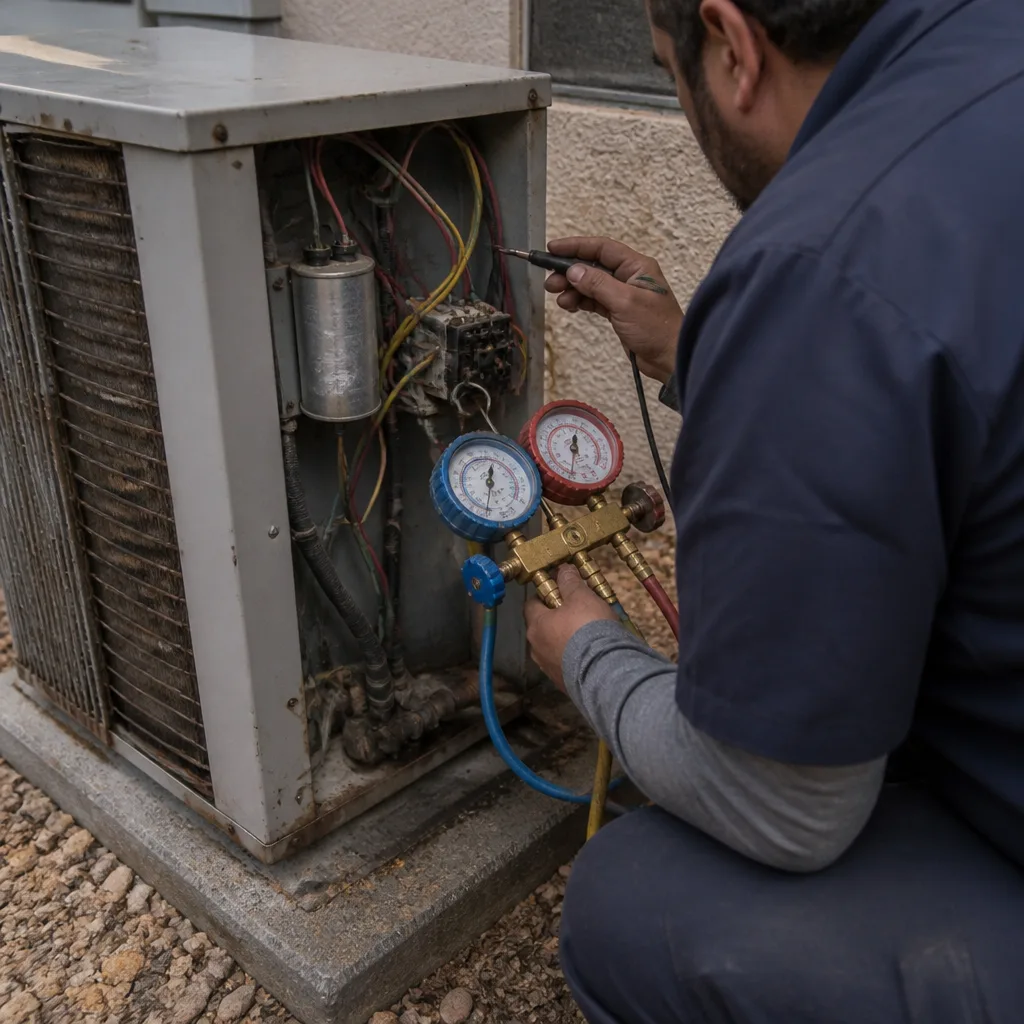 Before
 After
 Before
 After
 Before
 After
When to Call a Professional
Call a professional if any of the following is true: you found a diagnostic code pointing to the pressure switch, the inducer motor, or the limit switch; the furnace has tripped its own safety limit more than once; the burners light and go out; the furnace won’t power up even after you’ve checked the breaker and the door switch; you smell gas; you see a flame that looks wrong; or any code, chart, or symptom suggests a cracked heat exchanger. In those last two cases, leave the furnace off until a technician says otherwise. A furnace that’s been reset multiple times for the same problem also belongs on that list.
Dalton Heating & Air Spring Valley offers free estimates in Spring Valley – call (888) 268-6106 and a live person will pick up, day or night.
Frequently Asked Questions
The blinking LED on your furnace control board is a diagnostic code. The blink pattern between pauses corresponds to a legend printed on a sticker on the back of the lower burner access door. Count the blinks, find the legend, and write down the code. For example, two blinks followed by a pause and two more blinks would be matched to the chart as code 2-2 on a Carrier or Bryant board.
Yes, for a single lockout fault – a furnace that tried to ignite once and failed. Turn the switch off, wait 30 seconds, turn it back on, and watch one full cycle. Never reset a furnace more than twice in one heating season for the same fault, and never reset a furnace showing a heat exchanger or repeated limit switch fault. Those mean keep it off and call. If you’re in Spring Valley and unsure, call us at (888) 268-6106 and describe the code before you reset anything.
A running blower with cool air usually means the flame sensor is dirty or the air filter is clogged. The thermostat is calling for heat, the board is alive, and the blower is running, but the furnace either can’t prove flame or is tripping the limit switch on a heat buildup from restricted airflow. Check the filter first, then read the LED code.
Most furnace repairs run $150-$450 depending on the part. A flame sensor cleaning runs about $90-$150. An igniter replacement runs $120-$220. A pressure switch replacement runs $150-$350. An inducer motor replacement runs $350-$650, and a blower motor replacement runs $400-$800. We quote a written price before any work starts. Call (888) 268-6106 for an exact quote – estimates are free.
The pressure switch confirms the furnace’s exhaust vent is drawing air properly before it allows the burners to light. If the switch won’t close, the burners never fire, because the furnace is designed to stay off rather than push exhaust gases into the home. A failed switch, a blocked vent, or a frozen condensate drain all produce the same code.
A single-fault overnight quit in Spring Valley is often a frozen or blocked outdoor condensate termination on a high-efficiency furnace. Cold, dry air at a slow drain point freezes the run and stops the vent’s draft, so the pressure switch won’t close. The furnace is not broken; the drain needs clearing or rerouting. Call (888) 268-6106 and we’ll take a look.
The Bottom Line
The diagnostic code is the single most valuable piece of information in your furnace troubleshooting arsenal, and it’s available for free if you know where to look. Read the LED, count the blinks, match it to the chart, and photograph what you found. That one step tells you whether your furnace is a sensor cleaning or a heat exchanger. It shortens the diagnosis from a fishing trip to a straight line. It also makes sure you’re not sold a part the code has already named as good. For the rest, know your limits: gas, wiring, and heat exchangers are for a trained professional. That’s the difference between a smart homeowner and a lucky one.
If your furnace is down and you’re in Spring Valley, call Dalton Heating & Air Spring Valley at (888) 268-6106 for a free estimate. A live person answers 24 hours a day, seven days a week. Your price is in writing before any work starts, on every job, and every repair carries our 365-Day Done Right Promise – if it fails within the year, we come back at no charge. We service all nine major furnace brands: Carrier, Trane, Lennox, Goodman, Rheem, York, Daikin, Bryant, and American Standard.
Written by the team at Dalton Heating & Air Spring Valley.