
Preparing Your Home’s HVAC for Winter in Spring Valley
Las Vegas recorded 25 nights below freezing in the winter of 2022-23. That’s short by northern standards, but it’s plenty of cold to freeze a neglected evaporative cooler line, crack a heat exchanger that ran all summer on a dirty filter, or throw a heat pump into lockout on the first 38°F night. Spring Valley winters don’t demand the checklist they publish in Minnesota. They demand the specific ones that matter here, on the equipment that actually sits in Clark County homes.
Here’s a direct answer: to prepare for winter in Spring Valley, drain and cover the swamp cooler, replace the filter after summer’s dust load, test the furnace’s first fire with a real combustion check, and understand your heat pump’s defrost cycle before January. If you’d rather not climb on the roof or pull a burner door, call (888) 268-6106.
Key Takeaways
- The top three failures we see every winter in Spring Valley are a clogged filter that trips the high-limit switch, a bird’s nest in a PVC furnace flue, and a heat pump locked out by a defrost cycle the homeowner didn’t understand.
- A filter that’s been running since June in Spring Valley’s dust is at or past capacity. Replace it before the first cold snap, not after.
- Frost on a heat pump in January is usually normal. Ice that stays for hours is not.
- A real fall tune-up is a named list of tasks, not a “21-point inspection.”
- Clark County NV Energy customers can pre-schedule thermostat setbacks before cold snaps to ease peak demand charges.
Why Spring Valley’s Winter Prep Isn’t the Same as a Cold-Climate Checklist
Most winter HVAC guides are written for homes that see weeks of sub-freezing weather. Spring Valley sees a handful of sharp snaps, usually in December and January, sometimes dipping into the mid-20s for a night or two. That pattern is exactly what makes it risky. Equipment here sits idle for eight months, then gets asked to run hard for a week. The first cold night finds everything the summer left behind: dust on the flame sensor, debris in the flue, a filter packed solid, a defrost board that hasn’t cycled since last February.
If you’ve ever had a furnace fail at 9 p.m. on the coldest night of the year, you know it isn’t the cold that broke it. It’s whatever was already wrong that the cold exposed. Spring Valley homes in the 89147 and 89148 ZIP codes sit in newer subdivisions where a lot of the equipment is now in the ten-to-fifteen year window, which is exactly when ignition components and blower motors start asking for attention.
One more thing that’s specific to the neighborhood: the number of Clark County homes still running a roof-mounted evaporative cooler alongside their furnace. If you’ve got a swamp cooler, it needs to come off the circuit for the season. Water left in the line will freeze and split it. That’s a spring repair bill you don’t need.
The Heat Pump Defrost Cycle: What’s Normal and What Isn’t
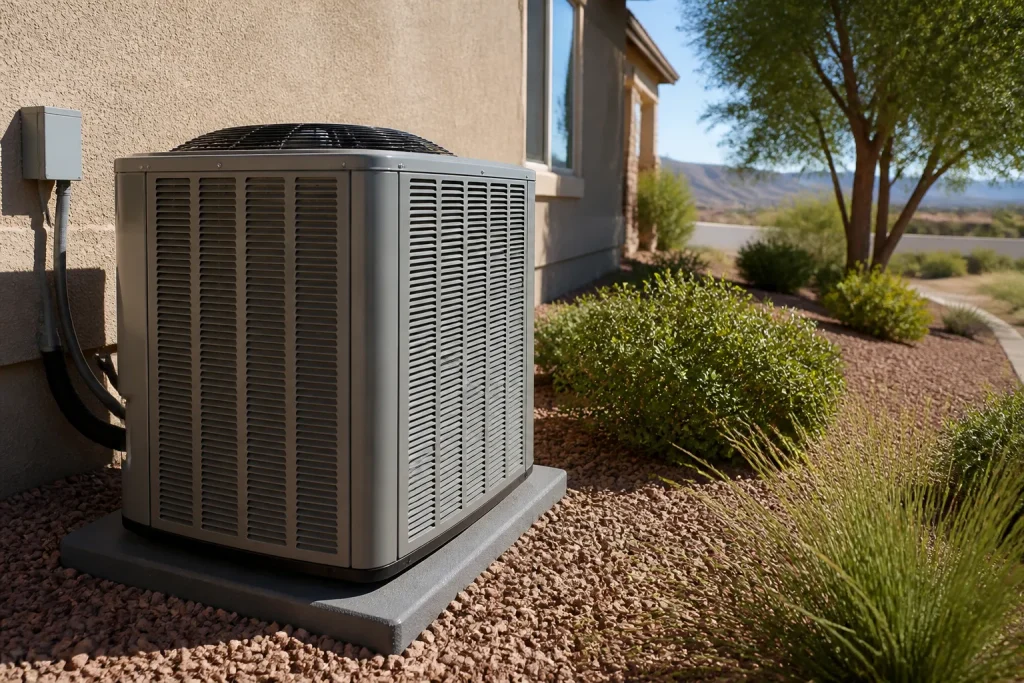
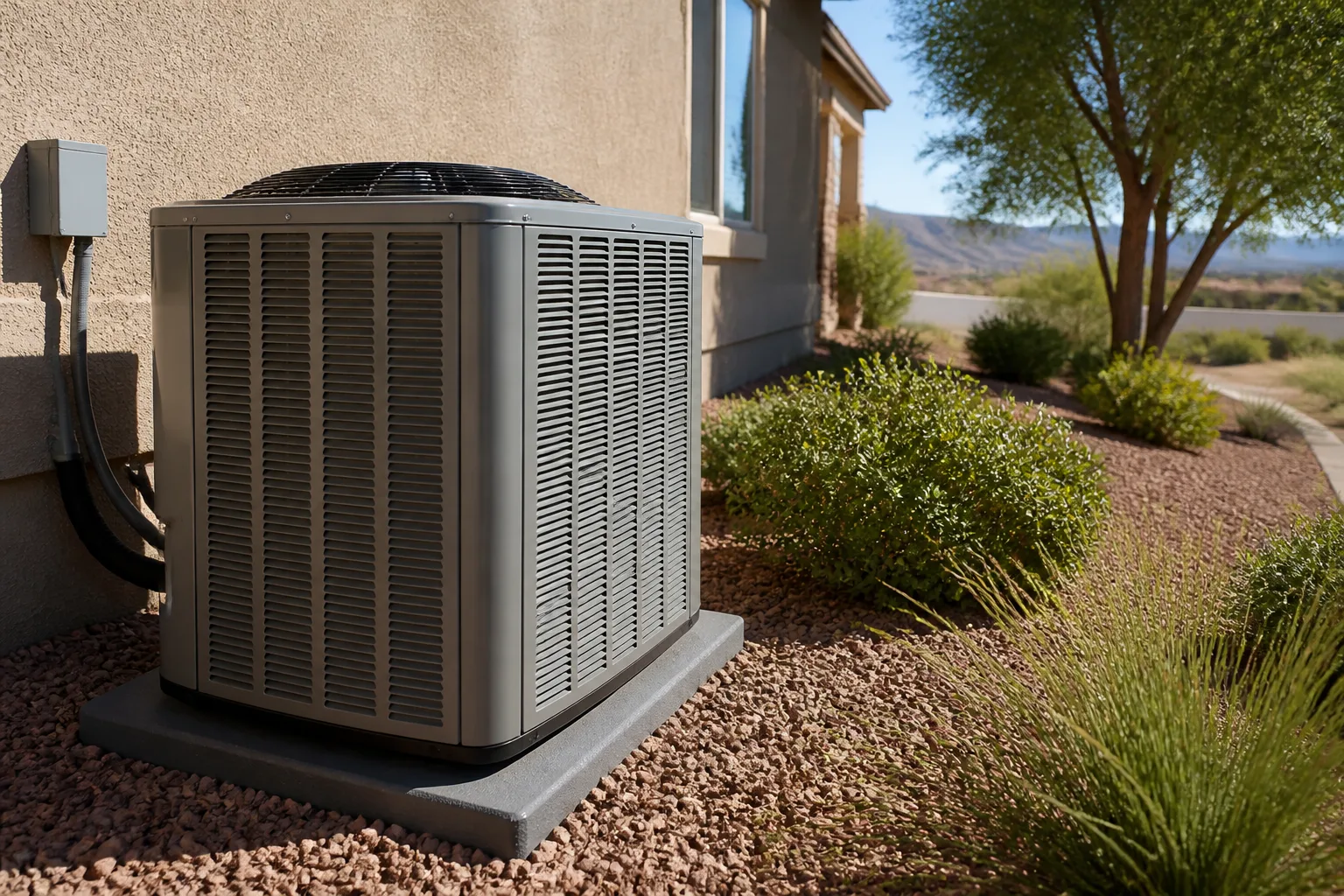
Heat pump owners in Spring Valley call us in January more than any other month, usually convinced their unit is broken. Most of the time it’s doing exactly what it’s supposed to. Here’s how the defrost cycle works in plain terms: when outdoor temperatures drop, the heat pump’s outdoor coil can gather frost, because it’s pulling heat out of cold air. The unit switches into defrost mode, briefly runs in reverse to warm and melt that frost, and you’ll see steam rise off the top. That’s normal operation, not a malfunction.
What’s normal:
- Frost that appears and clears every 30 to 90 minutes.
- Steam or visible moisture rising off the outdoor unit during a cold, humid morning.
- The outdoor fan stopping briefly while the unit defrosts.
- Indoor air feeling neutral for five to ten minutes during a defrost cycle.
What’s actually a problem:
- Ice that builds up and stays for hours. That’s a defrost board, sensor, or reversing valve issue.
- The heat pump running in defrost on a mild day with no frost at all.
- Water pooling and re-freezing around the base of the unit.
- The system kicking into aux heat on every cycle, which jacks your bill up.
If you’re seeing any of the four above, that’s the moment to call. A heat pump that never fully defrosts will lose capacity fast, and in Spring Valley that usually means emergency service at the worst possible time. Our technicians are factory-trained on Carrier, Trane, Daikin, and the other six major brands, so a defrost diagnosis isn’t guesswork.
The Furnace First-Fire Checklist Specific to Spring Valley
The first time your furnace fires up in November, it’s doing something it hasn’t done since February. That’s the moment the problems surface. Here’s what a proper first-fire test covers, and why each step matters here specifically:
- Clear the PVC flue exhaust of summer debris. This one surprises people. Birds nest in PVC flue pipes in this region because the pipes run horizontally out the side of the house, and they’re warm in the morning. A blocked exhaust trips the pressure switch and shuts the furnace down. We’ve pulled a full nest out of a flue in Rhodes Ranch more than once.
- Verify the flame sensor isn’t coated. Summer dust settles on the sensor rod, and when the furnace fires for the first time, it doesn’t sense flame and shuts off within seconds. Clean the rod and the furnace runs. Ignore it and you get three short cycles and a lockout.
- Test the pressure switch hose for cracking. Rubber hoses dry out over summer and split. A cracked hose means the furnace can’t prove draft and won’t fire at all.
- Run a combustion analysis. A combustion analyzer reads your CO levels and oxygen. Numbers outside spec mean a heat exchanger or burner problem that should be addressed before it runs all winter.
- Measure temperature rise across the heat exchanger. If the air entering and leaving the furnace don’t differ by the manufacturer’s spec (usually 30-60°F), you’ve got a duct, blower, or gas pressure issue.
- Read gas pressure at the manifold. Low pressure starves the burners. High pressure can overheat the heat exchanger. Both get caught here or not at all.
If you skipped one of these on your fall tune-up, you got a visual inspection, not a tune-up. Our Furnace Repair in Spring Valley team runs the full list on every call, price in writing before we start.
Filter Load After Summer: The Most Overlooked Prep Step
Spring Valley’s summer dust load is real. Between the dry June-through-September stretch, the wind events, and the construction in newer subdivisions, a filter rated for three months is usually done in six to eight weeks. If you ran the same filter through the whole cooling season and into fall, it’s past capacity. Here’s the consequence: a clogged filter restricts airflow across the heat exchanger, which causes it to overheat, which trips the high-limit switch (the safety device that cuts the burner when the heat exchanger gets too hot). The furnace shuts down mid-cycle. It restarts, overheats, shuts down again. Homeowners call it “the furnace won’t stay on.” Nine times out of ten the fix is a clean filter and a reset.
Get in the habit of this: check the filter the first weekend of every month, hold it up to a light, and if you can’t see through it, change it. In Spring Valley, we recommend a MERV 8 to MERV 11 filter for most homes, not the highest-rated MERV 13 or 16, because those restrict airflow on standard residential blowers. If someone in the house has allergies, MERV 11 is usually the right ceiling. Anything denser and you’re trading filtration for capacity.
If your furnace is going into high-limit lockout and you’ve already changed the filter, that’s when to call. Our AC Repair in Spring Valley team also handles the heating side, and we can run the full limit circuit to find the cause.
NV Energy Demand Response and Pre-Scheduling Setbacks in Clark County
Clark County NV Energy customers enrolled in the utility’s demand response programs have a specific window they should be thinking about this time of year. On a cold snap, the entire region pulls hard on the grid at the same time (usually 6-9 a.m. and 5-8 p.m. when people are waking up or getting home), and that’s when the peak demand charges kick in. The fix isn’t to freeze. The fix is to pre-schedule a thermostat setback before the cold front arrives so your system pre-heats the house during off-peak hours and then coasts through the peak.
If you’ve got a smart thermostat (Ecobee, Nest, Honeywell, or one built into a Daikin or Bryant communicating system), schedule it like this:
- Pre-heat to roughly 70-72°F starting two hours before the peak window opens.
- Set back to 66-68°F during the peak hours.
- Resume normal setpoint after the peak window closes.
During a Snap event (some NV Energy programs use the term), the utility may cycle the outdoor unit off in short bursts. Don’t fight it and don’t override it repeatedly. Your house’s thermal mass holds most of that heat through a 15-20 minute cycle just fine. The energy savings and the comfort both come from being ahead of the cold snap, not reacting to it.
If your thermostat isn’t programmable or the schedule is a mystery, a service call to sort it out before Thanksgiving is cheaper than a first-frost emergency visit. We do this on every fall tune-up.
What a Real Fall Tune-Up Should Actually Include
When a company advertises a “21-point inspection” or “full safety check,” ask for the list in writing before you book. Vague point counts are how services pad a checklist with “verify unit is plugged in” and call it a tune-up. Here’s what a legitimate fall HVAC service call should look like, and this is exactly what we perform on a standard fall visit in Spring Valley:
- Combustion analysis with a calibrated analyzer (CO, CO2, O2, and temperature readings)
- Temperature rise measurement across the heat exchanger, compared to the manufacturer’s spec
- Gas pressure reading at the manifold, high side and low side
- Flame sensor cleaned and tested
- Igniter inspected and gap-checked
- Pressure switch hose inspected for cracking or dry rot
- Flue and exhaust pipe inspected for obstruction
- Heat exchanger visual and camera inspection where accessible
- Filter replaced
- Blower wheel and motor checked for dust accumulation
- Condensate line cleared (for high-efficiency units)
- Thermostat calibration and schedule set
- Safety controls tested (high limit, rollout switch, flame rollout)
If a technician can’t show you that list on paper, you’re paying for a visual check. Our fall tune-ups show you the results in writing before we leave. And every repair carries a written guarantee for a full year: if it fails in that window, we return at no charge. That’s The Garrison Standard, not an upgrade.
If your home is on a heat pump and you’re thinking about the longer term, Heat Pump Installation in Spring Valley has the load-calculation details for our region, which matter more here than people realize because of the extreme summer load and the short shoulder seasons.
When to Call a Pro
Some of this is genuinely DIY territory. Changing a filter and reading a thermostat schedule are homeowner jobs, and we’d rather you do those yourself and save the service call. But there’s a real line: any work on gas supply, combustion, the heat exchanger, or the electrical panel behind the furnace is not a weekend project. A furnace that’s been sitting on a clogged filter all summer may have a cracked heat exchanger, and a cracked heat exchanger can push carbon monoxide into the living space. That’s not a variable you mess with.
Similarly, if you’re on a heat pump and the unit goes into hard lockout on the first 38°F night of the season, or if your furnace runs three cycles and shuts down repeatedly, those need a technician with a combustion analyzer and a diagnostic meter, not a YouTube tutorial. That’s the call where you get the price in writing before any work starts, and the gauge on the front of the visit is that we tell you what’s wrong before we touch anything.
Related services in Spring Valley:
- Furnace Repair in Spring Valley – first-fire failures, high-limit trips, ignition issues
- AC Repair in Spring Valley – off-season diagnostics and the same-day service line
The Bottom Line
Spring Valley’s winter isn’t a season, it’s a patch of cold nights dropped into an otherwise mild stretch, and that’s exactly why the failures catch people off guard. The filter, the flue, the pressure switch hose, and the defrost cycle are the four things that turn a short cold snap into an emergency service call. Handle them in October and November, and January takes care of itself.
Our technicians have up to 23 years of experience, we’re factory-trained on nine major brands (Carrier, Trane, Lennox, Goodman, Rheem, York, Daikin, Bryant, and American Standard), and the phone is answered by a live person 24/7. Every job carries a written price before any work begins and a written guarantee for a full year. If the work doesn’t hold, we come back at no charge. If it’s not done right, we make it right under our 365-Day Done Right Promise.
If you’re in Spring Valley and need help, Dalton Heating & Air Spring Valley offers free estimates. Call (888) 268-6106 and get the cold-weather check on the calendar before the first snap.
Start with our Dalton Heating & Air Spring Valley home page if you want the full picture of what we service and how the process works.
Frequently Asked Questions
Spring Valley is a Las Vegas suburb, and the metro recorded 25 nights below freezing in the winter of 2022-23. Most years see a few nights in the mid-to-upper 20s, mainly in December and January. That’s cold enough to freeze an evaporative cooler line, trip a heat pump into lockout, or expose a furnace that’s been sitting unused since February. Winter prep is absolutely necessary in Spring Valley, but the checklist is different from what colder climates need. Call (888) 268-6106 if you’d like a written estimate on a fall tune-up.
Yes, up to a point. Frost that appears and clears every 30-90 minutes is the defrost cycle doing its job, and you may see steam off the outdoor unit during a cold morning. That’s normal. Ice that builds up and stays for hours is not normal and usually points to a defrost board, sensor, or reversing valve issue. If you’re seeing persistent ice or the system won’t recover, call (888) 268-6106 for a diagnosis – we service Daikin, Bryant, and other major brands on-site.
Most furnace repairs in Spring Valley run $150-$450 depending on the part. A flame sensor clean is at the low end. A pressure switch, igniter, or blower motor replacement pushes toward the higher end. A heat exchanger replacement is more, and how much depends on the unit. Every repair through Dalton Heating & Air Spring Valley gets a written price before any work starts, and a written guarantee for a full year. Call (888) 268-6106 for an exact quote – estimates are free.
It depends on age and repair cost relative to replacement. A furnace over 15 years old with a repair bill over $1,200 is usually a replacement conversation, not a repair one. A furnace under 12 years old with a single failed component is almost always a repair. We’ll run the numbers with you in writing before you decide, and we won’t push a replacement when a repair will do. Call (888) 268-6106 for a free estimate and we’ll walk you through the same-day-vs-scheduled options.
Written by the team at Dalton Heating & Air Spring Valley.
Need HVAC Help?
Call Dalton Heating & Air Spring Valley - licensed & insured, here with fast after-hours help in Spring Valley.
(888) 268-6106