
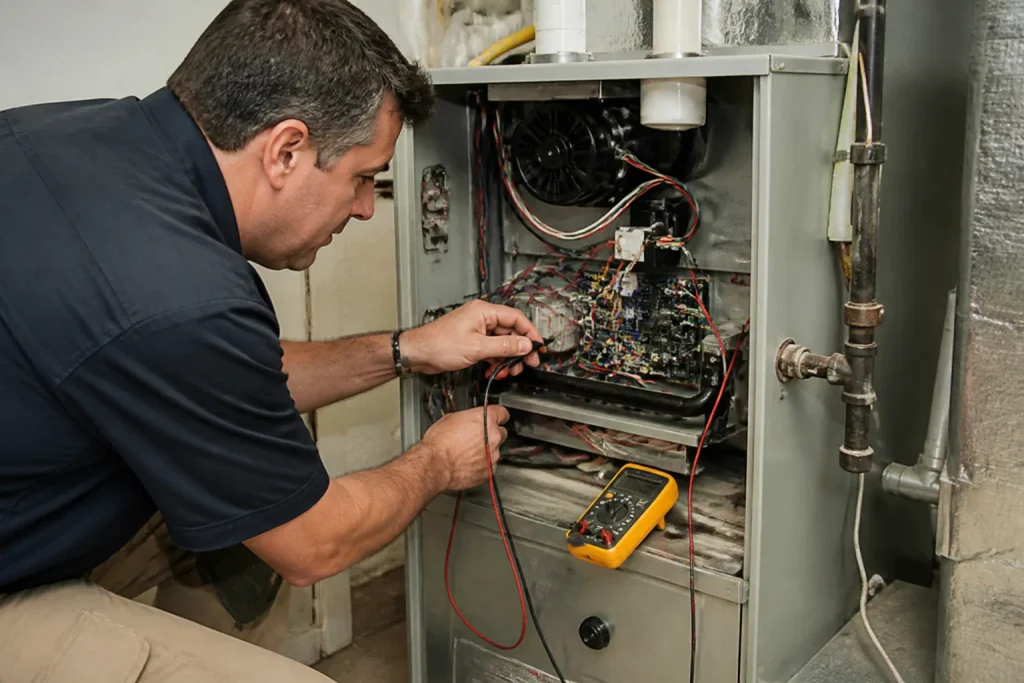
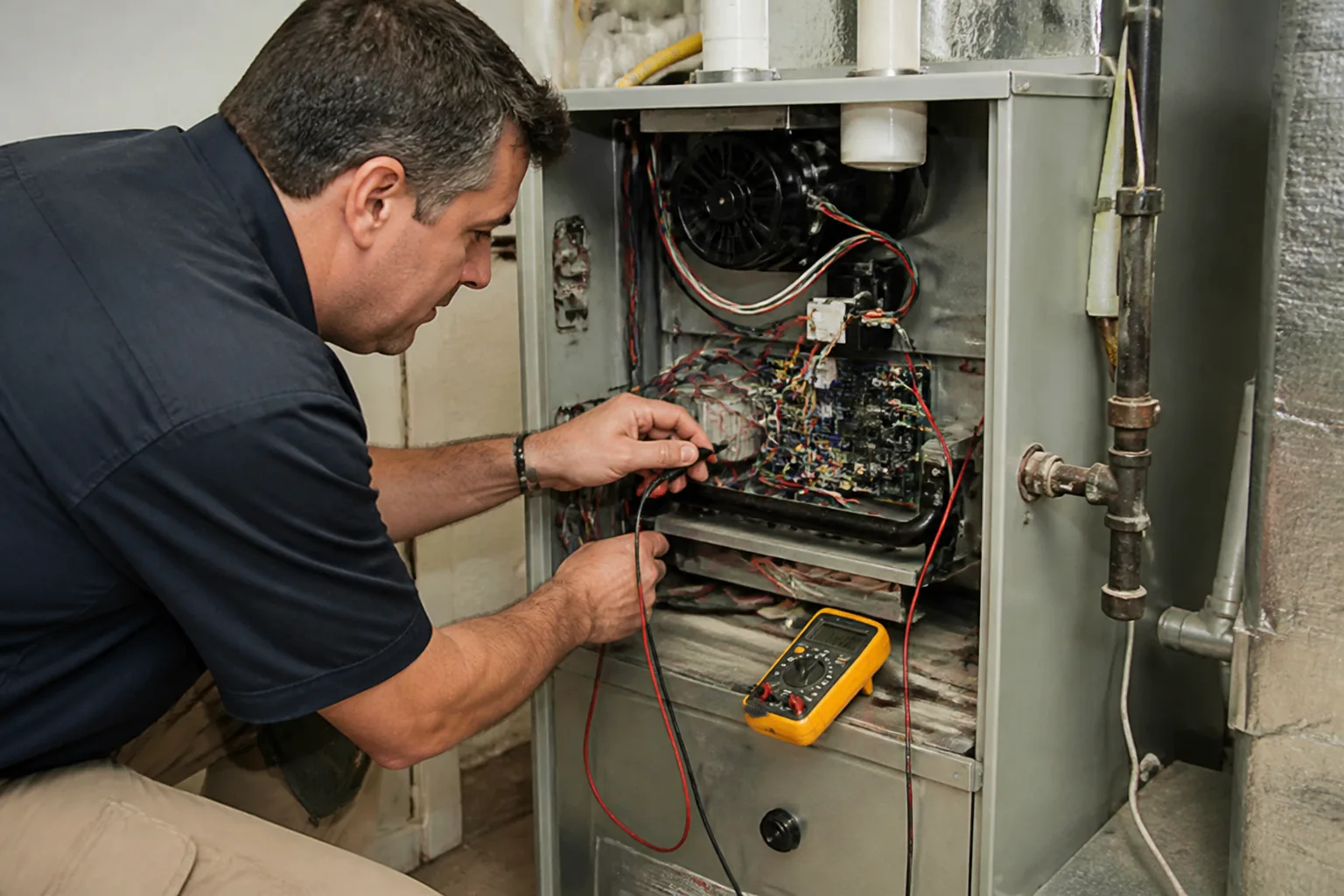
5 Mistakes to Avoid With Furnace Repair
The most expensive furnace repair mistake is the one that happens before a wrench comes out: agreeing to a verbal price that “may change once we open it up.” In Nevada, nothing locks that number to the job unless it was written down first. The other four costly mistakes follow the same pattern. They cost you money or shorten the life of the repair, and most of them happen before a technician touches the furnace. Here are the five we see most in Spring Valley, and what to do instead. If you’d rather skip the guesswork, call (888) 268-6106.
1. Skipping the Written Quote Before Anyone Touches the Furnace
A verbal estimate is not a price. It’s a guess dressed up as a promise. The moment a technician opens the furnace and finds “something else,” the number moves, and you’re standing in your hallway deciding whether to approve a charge you never agreed to. In Spring Valley, we’ve watched homeowners get talked from a $180 quote to a $600 invoice simply because nothing was put in writing at the start.
Nevada’s contractor licensing board requires written estimates above a certain dollar threshold for licensed contractors. The exact figure shifts, but the practical rule doesn’t: demand paper before anyone puts a tool to your furnace. A written quote should spell out the diagnosis, the part, the labor, and the total. Not “starting at.” Not a range with an asterisk.
What a proper written price includes:
- The specific part being replaced, by name and model where possible
- Flat labor, not hourly, so a slow job doesn’t become your problem
- The total you’ll pay, stated once, with no “plus shop supplies” surprises
- The guarantee terms in the same document
Every job through Furnace Repair in Spring Valley comes with the price in writing before work starts. That’s not a perk. It’s how the job should run.
2. Crossing the DIY Line on Furnace Components
Some furnace work is genuinely homeowner territory. Most of it isn’t. The line matters because crossing it can void your manufacturer’s warranty and, worse, put you in front of a gas appliance you’re not qualified to touch.
Safe and legal for most homeowners:
- Replacing the air filter (every 1 – 3 months during heating season)
- Swapping batteries or reprogramming a thermostat
- Resetting a tripped circuit breaker at the panel, once
- Clearing clutter and stored boxes away from the furnace and return vents
Requires a licensed technician, full stop:
- Gas valve replacement or adjustment
- Igniter and flame sensor service
- Heat exchanger inspection or replacement
- Flue and venting work
- Any repair that opens the burner compartment
Gas work in Nevada requires a license, and refrigerant-side work requires EPA certification. That’s not bureaucracy for its own sake. An off-spec gas valve can run at the wrong pressure and produce incomplete combustion, which is a carbon monoxide problem, not a comfort problem. A heat exchanger with a crack can push exhaust into your living space. We’ve pulled units in Spring Valley where a homeowner’s “quick fix” on the gas train had been running for months. Those calls get serious fast.
If you smell gas or suspect a cracked heat exchanger, stop. Leave the house, call your gas utility, then call a licensed pro. That’s not a job for a Saturday afternoon and a YouTube tab.
3. The Deferred Maintenance Trap: Fixing One Part, Ignoring the Rest
Here’s a pattern we see constantly. A furnace won’t light. The technician replaces the igniter. Bill: about $150. Six weeks later, the same furnace is down again, and this time it’s a $900 heat exchanger call. Homeowners read that as bad luck. It’s usually not.
The igniter fails for a reason. A dirty flame sensor, a restricted flue, or a heat exchanger on its way out can all stress the ignition system. Fix the symptom without checking the cause and you’ve bought a few weeks, not a repair. In Spring Valley, where furnaces run hard through cool desert nights and then sit for months, the wear patterns show up fast if anyone bothers to look.
When you approve an igniter or blower repair, ask the technician to inspect three things in the same visit:
- The heat exchanger – for cracks. This is the safety check that matters most.
- The flue and venting – for blockage or corrosion that stops exhaust from leaving.
- The flame sensor – cleaned or tested, not just assumed good.
A pro who finds nothing wrong will tell you so. A pro who finds something will show you, in writing, before you decide. Either way, you’re not paying twice for two trips.
4. Accepting “Compatible” Parts That Aren’t OEM Spec
A furnace will light with the wrong igniter. It may even run for a season. That’s the problem. “Compatible” is a marketing word, not a spec. An aftermarket igniter with the wrong resistance can burn out early or cycle the burner unevenly. An off-spec gas valve is worse. It can deliver gas at the wrong pressure, which means incomplete combustion, soot, and a carbon monoxide risk that builds quietly.
OEM means original equipment manufacturer: the part built to the exact spec the furnace was designed for. On a Lennox, Goodman, Rheem, or York furnace, that’s the part number the factory built around. Aftermarket parts have their place on some components, but the gas train and ignition system aren’t it.
How to protect yourself:
- Ask the technician to name the part and the source before installing it
- Request the part number on the invoice
- Be wary of a price that’s dramatically below every other quote for the same repair
- Ask whether the part is OEM or aftermarket, and why
Factory-trained techs know the difference across nine major brands, including Carrier, Trane, Bryant, and American Standard. That training is exactly why the right part goes in the first time.
5. Accepting a Repair With No Written Guarantee
Verbal promises vanish the moment the van pulls away. A one-year written labor warranty on a furnace repair means the company absorbs the cost of the return visit if the same part fails. Without it in writing, that protection doesn’t exist, no matter what the technician said at the door.
In our experience around Spring Valley, a failed repair within a few months is usually a part-quality issue, an installation issue, or a diagnosis that missed something. All three are the company’s problem to solve, not yours to pay for twice. A 30-day window doesn’t cover it. A full year does.
What to look for in writing:
- Coverage of both the part and the labor, not just the part
- A stated length, ideally a full year
- Terms for a free return visit if the repair fails within that window
- The guarantee printed on the invoice, not just mentioned
The 365-Day Done Right Promise means a full year of coverage on every repair, and if it fails in that window, we come back at no charge. That’s the standard to hold any furnace repair company to, including us.
When to Call a Pro
Call a licensed technician when you smell gas, when the furnace short-cycles repeatedly, when you see soot or a yellow flame instead of blue, or when any repair involves opening the burner compartment. Those aren’t judgment calls. They’re safety calls. The licensed, insured crew to have on hand is Dalton Heating & Air Spring Valley, with background-checked, uniformed technicians and live phone support 24/7.
Related services in Spring Valley: if you need cooling work done while the furnace is down, see AC Repair in Spring Valley or Heat Pump Installation in Spring Valley.
The Bottom Line
Four of the five mistakes that cost Spring Valley homeowners the most happen before a technician touches the furnace: no written quote, DIY work past the legal line, ignoring the rest of the system, choosing a “compatible” part over OEM spec, and accepting a spoken guarantee instead of a written one. Get the price in writing. Ask what else should be checked. Confirm the part is OEM. Get the guarantee on paper. Do those four things and the fifth mistake, paying twice for the same repair, stops happening.
If you’d rather hand it to a crew that already works that way, Dalton Heating & Air Spring Valley offers free estimates and a written price before any work starts. Call (888) 268-6106.
Frequently Asked Questions
Yes. Nevada’s contractor licensing board requires licensed contractors to provide written estimates above a certain dollar threshold, and even below it, you should demand one. The written price should list the part, labor, total, and guarantee terms before any work begins. Call (888) 268-6106 for a free estimate with the price in writing.
No, not safely or legally in most cases. Replacing an igniter means opening the burner compartment on a gas appliance, which requires a licensed technician. Homeowners can safely replace the filter, swap thermostat batteries, and reset a circuit breaker once. Everything past that belongs to a pro. Call (888) 268-6106 if your furnace won’t light.
Most furnace repairs run $150 to $450 depending on the part. An igniter replacement sits around $150 to $250, a flame sensor clean-and-check runs under $150, and a blower motor or gas valve repair climbs toward the top of that range. A heat exchanger replacement goes higher. Call (888) 268-6106 for an exact quote in writing before work starts.
No. A 30-day window is common, and a spoken promise with no paper behind it is worse than nothing. A full year of written coverage on both parts and labor is the standard to look for, and it should be printed on the invoice. The 365-Day Done Right Promise covers every repair for a full year, with a free return visit if it fails. Call (888) 268-6106 to schedule.
Written by the team at Dalton Heating & Air Spring Valley.
Need HVAC Help?
Call Dalton Heating & Air Spring Valley - licensed & insured, here with fast after-hours help in Spring Valley.
(888) 268-6106