
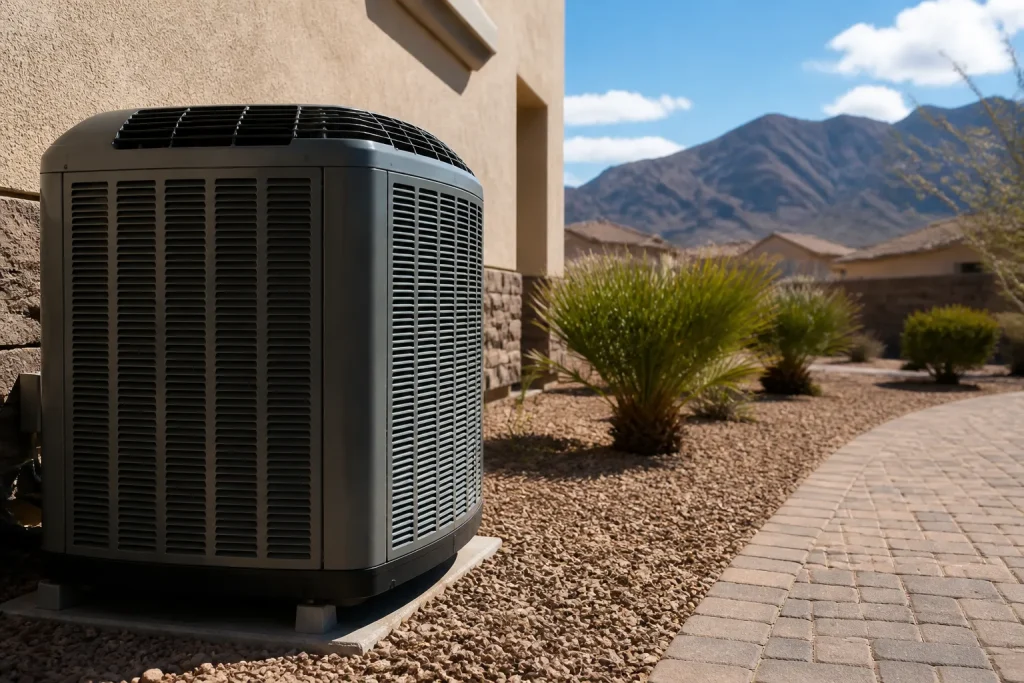
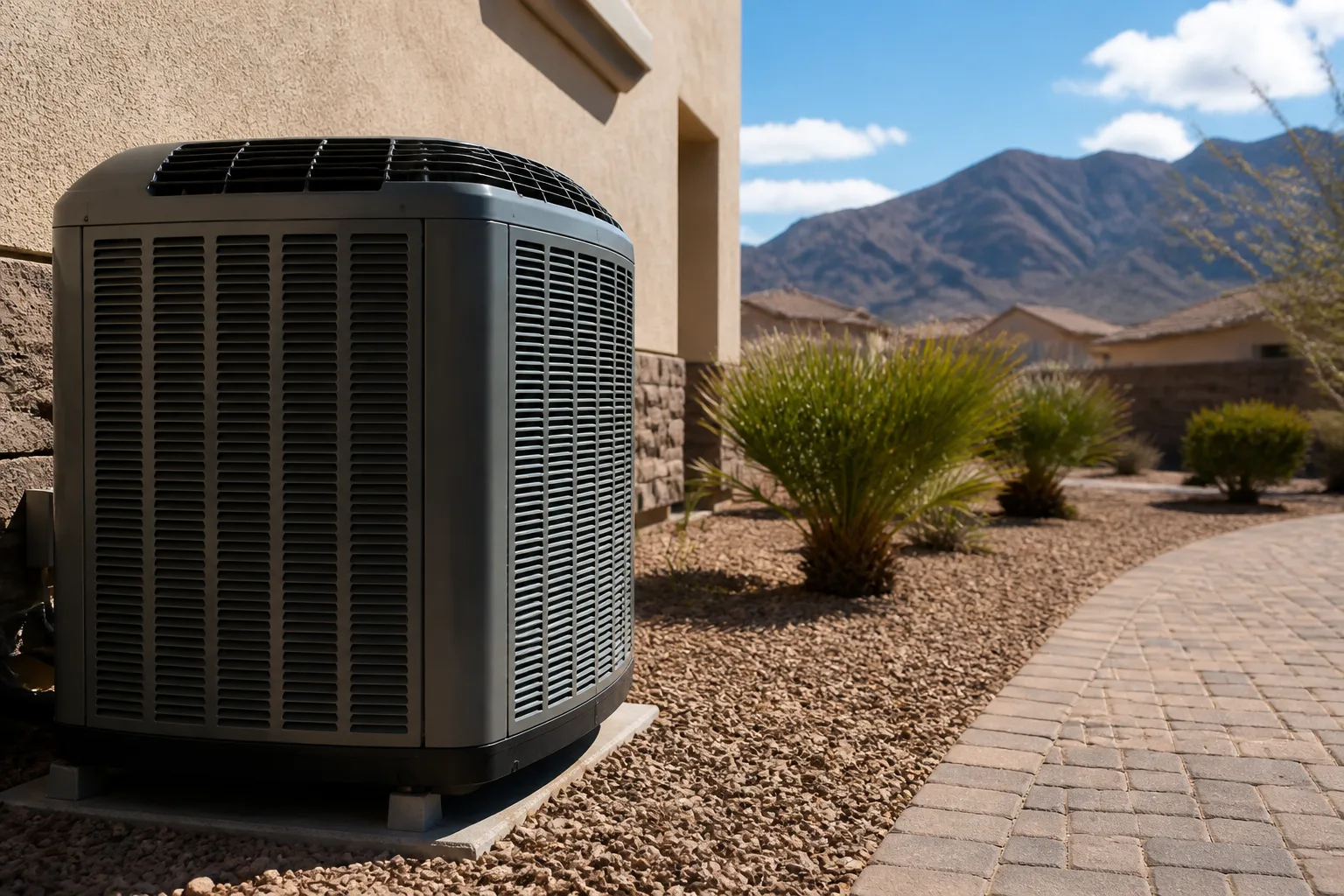
Trane AC Repair in Spring Valley: A Homeowner’s Guide
Trane’s slogan is “It’s Hard to Stop a Trane,” and mostly that’s true. But in Spring Valley, where an outdoor condenser runs 10 or more hours a day for six straight months, “hard to stop” just means the parts wear on a schedule. The failures we see most are the same three every summer: dual-run capacitors, contactor relays, and TXV valves. Knowing which Trane components quit first here tells you what any honest diagnostic should turn up before you approve a repair.
Why Spring Valley Heat Wears Down Trane Parts Faster Than the Manual Predicts
Trane builds equipment to last 15 to 20 years in a moderate climate, and in most of the country that holds up. Spring Valley isn’t a moderate climate. From May through October, your system isn’t cycling on and off the way it does in cooler parts of the country. It’s running almost continuously, pulling outdoor air that regularly crosses 110°F, and dragging desert dust through the condenser coil the whole time.
Run time is what kills parts. A capacitor that manages 40,000 start cycles over a decade back east might face that same load in Spring Valley in five or six summers. The dust makes it worse. Fine grit packs into the condenser fins and insulates them, so the compressor works harder and runs hotter, which pushes every electrical component downstream closer to its limit.
We’ve seen this pattern across the valley, from the older single-story homes near Flamingo and Durango to newer builds out toward Buffalo. The Trane systems are holding up well structurally. It’s the wear parts that need attention sooner than the manual suggests. That’s not a knock on the brand. It’s what a high-runtime desert climate does to any equipment, and knowing the schedule lets you plan for it instead of getting surprised in July.
The Three Trane Components That Fail Most Often in Spring Valley
In our experience servicing Trane systems around Spring Valley, three components account for the majority of summer breakdowns. Each one gives you a different clue from inside the house, if you know what to listen and feel for.
1. The Dual-Run Capacitor
A capacitor stores and releases the electrical jolt that starts your compressor and fan motor. Trane uses a dual-run capacitor that serves both at once. When it weakens, the system often still runs, but poorly. From inside the house you’ll notice the AC struggling to keep up, or the outdoor unit humming but the fan not turning. Sometimes you’ll hear a click-click-click from the condenser as it tries to start and gives up. In Spring Valley’s heat, a failed capacitor left alone can take the compressor with it, so this is worth catching early.
2. The Contactor Relay
The contactor is the switch that sends power to the compressor and fan when the thermostat calls for cooling. Dust and heat pit the contact points over time. The symptom is usually intermittent: the system short-cycles, cutting out and back in, or the outdoor unit refuses to start on the first try but works on the second. A pitted contactor in a Spring Valley summer can arc and weld shut, which keeps the compressor running when it shouldn’t. That’s a much bigger repair than the contactor itself.
3. The TXV (Thermostatic Expansion Valve)
The TXV is a metering valve that controls how much refrigerant enters the evaporator coil. It’s a small part with a big job, and heat stress makes it stick. When it fails, the system either starves the coil (weak cooling, ice forming on the indoor lines) or floods it (the coil ices over, then thaws and drips). You might feel cool air for a while, then lukewarm air with the fan still running. TXV replacement is more involved than a capacitor swap, and it’s the one place where the brand of the part genuinely matters, which we’ll get to below.
How to Find Your Trane Model and Serial Number (and Why It Matters Before You Pay)
Before you approve any Trane repair in Spring Valley, find your model and serial number. It takes two minutes and it could save you hundreds of dollars, because it tells you whether you’re still inside Trane’s 10-year registered limited warranty on parts.
Here’s where to look:
- The outdoor condenser: Open the service panel on the side of the unit (usually held by a couple of screws). The rating plate with model and serial numbers is on the inside of that panel, or on the back of the unit near the refrigerant lines.
- The indoor air handler: The plate is typically on the front or side panel of the air handler cabinet, often in the garage or a closet.
- Your original paperwork: The install invoice and warranty registration card usually have both numbers printed on them.
Now the useful part. On most Trane condensers, the serial number starts with a letter and a digit that decode the manufacture date. The format has shifted over the years, so if the plate is faded or you’re not sure which digits to read, snap a photo and have your technician read it. The point is this: Trane’s standard warranty covers parts for 10 years if the system was registered at install. If you’re inside that window, the TXV, the blower motor, or even a compressor may be covered for parts, and you’d only pay labor. If you’re outside it, you’re buying the part, and that changes what a fair quote looks like. A technician who doesn’t check your serial number before quoting parts isn’t doing the job.
Why Trane Communicating Systems Need a Tech With Brand-Specific Tools
If you own a Trane XV or XL series system, your equipment is a communicating system. That means the indoor and outdoor units talk to each other over a data connection, not just plain thermostat wiring. The system reports fault codes, modulates fan speed, and adjusts refrigerant flow on the fly. It’s efficient and it’s reliable, but it also means the diagnostic path is different from a standard single-stage unit.
Here’s the question to ask before you book anyone for Trane repair in Spring Valley: “Do you carry Trane-compatible diagnostic equipment on your van?” Trane’s communicating systems use proprietary communication protocols. A tech without the right tool can still swap a capacitor by eye, but they can’t read the fault history, can’t verify the communicating boards are talking correctly, and can’t properly diagnose a modulating system that’s misbehaving. We’ve seen homeowners pay for two or three “repairs” on an XV system before someone with the right equipment found the actual fault.
We’re factory-trained to service nine major residential HVAC brands, Trane among them, along with Carrier, Lennox, Goodman, Rheem, York, Daikin, Bryant, and American Standard. That factory training matters specifically on communicating systems, because the diagnostic approach differs from brand to brand. When you call, ask the question. A straight answer tells you a lot about who’s coming to your door.
Trane OEM vs. Aftermarket Parts: Where It Matters and Where It Doesn’t
When a repair quote lands in front of you, one of the first things to look at is whether the part is OEM (original equipment manufacturer, meaning genuine Trane) or aftermarket. Some shops default to aftermarket to shave the bottom line. Sometimes that’s fine. Sometimes it isn’t. Here’s the honest breakdown.
- Where OEM matters: TXV valves and blower motors. A TXV is calibrated to the specific refrigerant and coil in your system. A generic aftermarket valve can work, but it can also meter refrigerant wrong and leave you with poor cooling or a coil that ices over. Blower motors are matched to the air handler’s specific airflow and electrical spec. Getting that wrong affects efficiency and noise. On these, we use OEM.
- Where OEM vs. aftermarket is a wash: Capacitors and contactors. These are essentially electrical commodities. A quality aftermarket capacitor meets or exceeds the spec of the original, and the price difference is real. In a Spring Valley summer, a good aftermarket capacitor is a reasonable choice, provided it’s rated for the temperature and cycle load. What matters more than the brand print on the side is the microfarad rating matching your system and the part being spec’d for high heat.
Understanding this lets you read a quote intelligently. If you’re being charged OEM prices for a capacitor, ask why. If you’re being quoted aftermarket for a TXV on a Trane, ask if OEM is available and what the difference is. A professional shop will explain it, not dodge it.
What a Trane Repair Invoice Should Itemize
Spring Valley homeowners get burned less by price than by vagueness. A one-line invoice that says “AC repair – $480” tells you nothing and makes it hard to hold anyone accountable. A proper Trane repair ticket has four things on it, every time.
- The part number. Not just “capacitor” but the actual OEM or aftermarket part number. This lets you confirm the right part was installed and lets a second opinion verify it.
- Labor time. Stated as hours, not baked into a lump figure. Labor for a capacitor is 30 minutes. Labor for a TXV is a couple of hours plus a refrigerant recharge. Those are different jobs and the invoice should say so.
- Refrigerant weight added, if any. If the repair opened the refrigerant circuit (TXV replacement, coil work, leak repair), the invoice should show how many ounces or pounds of refrigerant went back in. EPA regulations require that tracking. A vague “topped off the refrigerant” line is a red flag.
- The written guarantee period. Every repair from a shop held to a real standard comes with a written guarantee in specific terms. Ours covers the repair for a full year in writing. If the repair fails in that time, we return at no charge. If your quote doesn’t spell out the guarantee period, ask before you sign.
We’ve pulled invoices out of garages over in the Spring Valley neighborhoods near Paradise Road where the customer was charged for a “compressor repair” that turned out to be a $40 contactor. Itemization protects you from that.
When to Call a Pro (and What Not to Touch Yourself)
Some of what we’ve covered is genuinely homeowner-checkable: reading your model and serial number, noting down symptoms, checking the air filter. The rest is not. Capacitors hold a charge that can stop your heart even with the power off at the breaker. The compressor circuit and contactor carry live high voltage. The refrigerant circuit involves EPA-regulated refrigerant and pressures that can cause serious injury. There’s no version of Trane repair in Spring Valley that a homeowner should attempt on the electrical or refrigerant side. If you see a bulged capacitor or a pitted contactor, close the panel, don’t touch the terminals, and call a trained technician.
Call a pro when you notice any of the following:
- The outdoor unit hums but the fan doesn’t turn (likely the capacitor)
- The system short-cycles, running for a few minutes and cutting out
- Cool air fades to lukewarm with the fan still running
- Ice forms on the indoor refrigerant lines or the evaporator coil
- The system runs constantly and can’t hold set temperature in Spring Valley afternoon heat
Our technicians have up to 23 years of experience, and every call comes with a written price before any work starts, plus our 365-Day Done Right Promise on the repair. If the fix doesn’t hold, we come back at no charge.
Related services in Spring Valley: AC Repair in Spring Valley for non-Trane systems and general AC service; Heat Pump Installation in Spring Valley if you’re weighing a replacement; Furnace Repair in Spring Valley for heating-side work; and the Dalton Heating & Air Spring Valley home page for the full service overview.
The Bottom Line
Trane equipment in Spring Valley holds up structurally, but the parts that fail first are predictable: dual-run capacitors, contactor relays, and TXV valves. Know where your model and serial plate is, check whether you’re still inside Trane’s 10-year registered limited warranty before approving parts, and ask any tech booking a Trane call whether they carry Trane-compatible diagnostic equipment on the van. On the invoice, expect a part number, labor time, refrigerant weight if any, and a written guarantee period. Those four line items separate a professional ticket from a vague receipt.
If you’d rather not chase the diagnostics yourself, that’s what we’re here for. If you’re in Spring Valley and need help, Dalton Heating & Air Spring Valley offers free estimates – call (888) 268-6106. We answer with a real person, 24 hours a day, seven days a week, and the price is in writing before any work starts.
Frequently Asked Questions
Most Trane repairs in Spring Valley run $180 to $450 depending on the part. A dual-run capacitor or contactor replacement typically lands at the low end of that range, while a TXV replacement (which involves opening the refrigerant circuit and recharging) runs higher, often $500 to $900 when you include the refrigerant. Call (888) 268-6106 for an exact quote on your system; estimates are free.
Often yes. Capacitor, contactor, and most common Trane electrical failures can be diagnosed and repaired the same day when we have the part on the van, which is most of the time. TXV replacements frequently need a follow-up because the refrigerant recharge is time-intensive. We’ll tell you exactly what’s happening before we start, with a written price. Call us to check availability.
Trane’s standard limited warranty covers parts for 10 years if the system was registered at install. To find out, locate the model and serial number on the outdoor condenser’s rating plate, and check the manufacture date encoded in the serial. If you’re inside the window, parts may be covered and you’d pay only labor. Call (888) 268-6106 with your serial number and we’ll walk you through it.
Yes. We’re factory-trained to service nine major residential HVAC brands: Carrier, Trane, Lennox, Goodman, Rheem, York, Daikin, Bryant, and American Standard. Whether you’re running a Rheem or a Daikin, the diagnostic approach is brand-specific, and we carry the tools for each. Call us for a free estimate on any brand.
Written by the team at Dalton Heating & Air Spring Valley.
Need HVAC Help?
Call Dalton Heating & Air Spring Valley - licensed & insured, here with fast after-hours help in Spring Valley.
(888) 268-6106